Part 2 - Mails in and out of London
The postal system had developed in a patchwork fashionduring the previous centuries and had been subjected to abuse, and criticism. However, when Henry Bishop was appointed Postmaster General, (1660-1663)the complaints were mostly against the delays imposed on the mail, so he introduced the system of dating the mail when it was received, in order that a check could be kept on it.

'a stamp is invented, that is putt upon every letter shewing the day of the moneth that every letter comes to this office, so that no letter Carryer may dare to detayne a letter from post to post; which, before, was usual.'
This was the first type of British Postmark, and is called a 'Bishop mark' after the inventor. It was first used in 1661 at the London Chief Office of the General Post Office in Bishopsgate Street, London. The Bishop marks showed the day and the month - the year could only be discerned from the letter. They were in use for about 80 years, and during this time they varied in size, shape and content. The first type of Bishop mark in use from 1661-1713 was a small circle bisected horizontally to show the month in the upper half and the day in the lower half.
Examples of early Bishop marks in use from 1667 to about 1787

Letter of 1686 For Mr Thomas Peacock, LONDON showing a small early type of Bishop mark. (see the row of bishop marks above) dated November 29th, shown as NO 29.
The letter has two other interesting points : the first is the address. London, at that time, was a busy and new city, having been quickly rebuilt after the disastrous Great Fire of 1666. But because in many cases the postage was paid only when the letter was delivered, the address gave explicit instructions to ensure correct delivery.

'For Mr Thomas Peacock
at ye Signe of ye Peacock in Ye
Strand near Ye May-pole,
London.'
(Everybody knew the Inns and their signs !)
The second point to notice is the manuscript '3', which indicated the charge applied for posting a letter a distance of more than 80 miles (1660-1711), which would have been paid by Mr Peacock.

<
The next two letters are examples of the use of the post office or post house. The first marked Post paid, and dated October 1717 is addressed to :-
Burrell Massingberd Esqr
at Sir. John Chester's
at Chichley
To be left att the Post Houfe in Newport Pagnel Bucks.
<
'Sir, if you please to send a trifle, please to direct to be left at the Post Office till called for'.
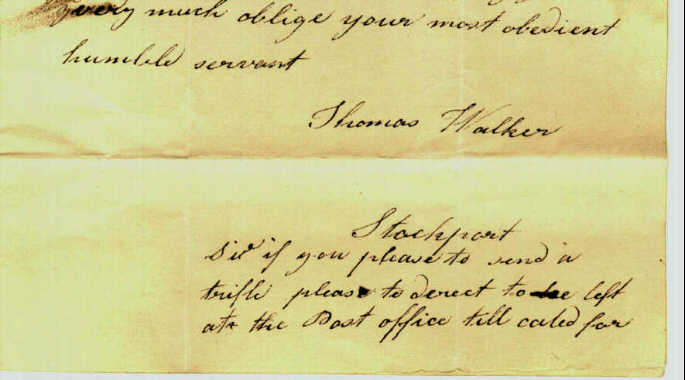
Since 1635, when the new Inland service was made available to the general public, the number of letters had increased and the number of routes extended. The original Proclamation in 1635 set up the posts to and from Ireland, and this letter of 1793 was sent from Londonderry to Lichfield in England. The writer of the letter indicated the route the letter was to take, by endorsing on the front 'By Dublin'
<
The letter below, dated 16 July 1781, addressed to Leith in Scotland has the larger size Bishop mark with the date (16) above the month (JY). The cost was 6d (sixpence) the rates had been increased in 1711.

The growth of the mail service
The growth of the mail service was so marked that there were soon four different sections within the Post Office dealing with mail in and out of London :
1 - The General Post - Inland Office - to deal with mail between London and the rest of the British Isles ;
2 - The Local Post of London (the Penny Post, later called the Twopenny Post) for mail posted and delivered within the city and country boundaries of London;
3 - The Foreign Section, to handle overseas mail ;
4 - The Ship Letter Office to handle mail which had arrived at the various ports and were then forwarded to London for delivery in other parts of Britain. Also mail to be despatched to the various ports for transport by Post Office Packet ships etc.
Both the Ship Letter Office and the Foreign section were part of the London Chief Office, but had their own staff and accounting. These two sections will be covered in a later chapter.
By 1680 the General Post Office was in Lombard Street, and received and despatched mail between London, and other parts of the United Kingdom. There were daily posts to Kent and Essex, alternate days to other parts of England and Scotland, and weekly to Wales and Ireland.
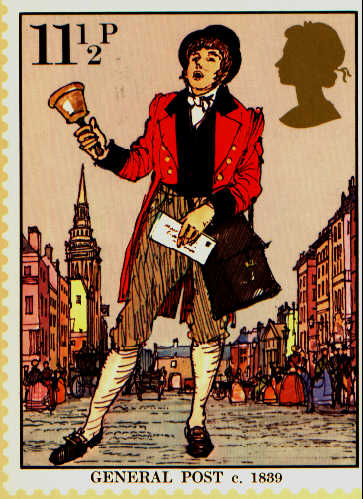 The GPO Inland Section controlled 32 letter carriers based there, (left)shows a Letter Carrier of the GPO in 1839. This is a reproduction of a stamp issued by the British Post Office to commemorate the death of Sir Rowland Hill.
(Notice the bell, used to alert the citizens of his appearance to deliver and accept letters).
The GPO also set up Receiving Houses throughout London.

The next letter is addressed to the Solicitor of Queen Anne's Bounty. This was a Benevolent Fund set up by Queen Anne, who reigned from 1702-1714. She was a very pious woman, most concerned about the Church of England. At this time, the vicars income was made up of 'Tithes', which was a tenth of one's annual income, and charged as a kind of tax on the parishioners.
In small parishes, where there were few wealthy people, the vicar may have been unable to exist on the small income. In this case, he was allowed to make a request for assistance to the Governors of Queen Anneís Bounty. There are many examples of such letters still in existence, proving such a fund was needed.
<
For many years coffee houses had been meeting places in London for merchants and traders, and the Post Office made use of these as Receiving Offices for letters. It was a very successful system which lasted for well over 100 years, as is shown by this example from Carmarthen in Wales to London dated 27th November 1780, addressed to Edmund Chalmer, Grecian Coffee House, Temple Bar. The '4' written on it is the rate for a single letter over 80 miles from London.
The London Penny Post
|
|
| This uniform which was retained until 1855, is shown here on a reproduction of another one of the British stamps issued to commemorate the centenary of the death of Sir Rowland Hill. |
With the growth of trade, and the increase in the population of London - about half a million people - there was an increasing demand for a local London Post.
William Dockwra and his partner Robert Murray launched such a service on 27th March, 1680, with much publicity, and offered to carry letters, and parcels, within the London area for the sum of one penny.
They started with a Head office in Lime Street, and 7 Sorting Offices. In two years it had grown so much that they required between 400 and 500 Receiving Houses, with messengers who delivered between 5 and 15 times every day.
The mail was marked with date and time stamps to show when and where the letter was posted, and that the penny postage had been paid.
The earliest known Dockwra postmark is dated 13.12.1680. Most actual Dockwra marks are on letters in archives and only about four are known to be in private hands.
The system which was widely acclaimed and well used, and also profitable, has never been equalled. The Duke of York, - the King's brother - complained, claiming it infringed the monopoly of the Post Office, from which he received the profits, which had been granted to him by Parliament in 1663.
As a result, Dockwra lost his Penny Post and it was incorporated into the General Post Office, which had thereby gained an efficient organised postal system.
So the new Government Penny Post opened on December 11th 1682. They continued to use the Dockwra system of postmarking the mail with a datestamp. But as the system developed the postmarks changed. In 1685 an abbreviated form of the day was added to the office letters in the centre, e.g. MO for Monday.
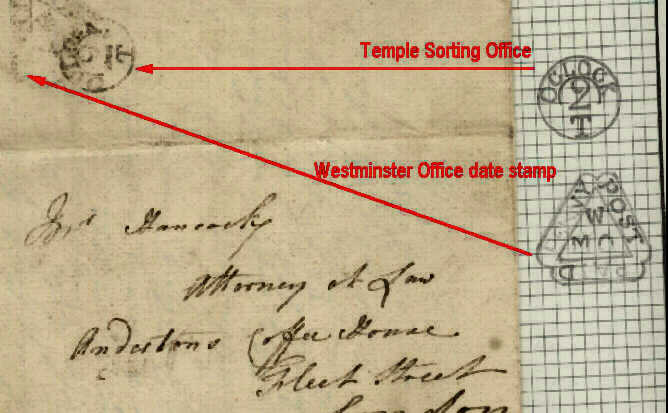
The letter which is dated 24th November 1790,is addressed to :-
'Mr Hancock,
Attorney at Law,
at Andertons Coffee House,
Fleet Street,
London.'
The Dockwra system worked on the basis of paying the one penny when the letter was accepted, and so the triangular stamp also showed the words PENNY POST PAYD on the three sides.
When the Government took over the organisation, pre-payment was not compulsory. But if the postage was pre-paid, they used a similar postmark. However, (unlike the Dockwra postmark), the words on their 'Paid' triangular datestamp read inwards, so the word on the bottom is always upside down.
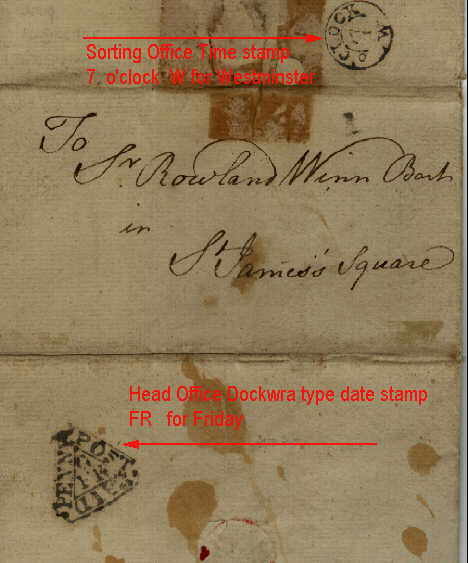
This letter was dated April 10th, 1767 and was addressed to :-
Sir Rowland Winn Bart.
in St. James's Square
which was in London, it also has the two date/time stamps. The triangular Dockwra type Government Penny Post stamp is the Head office type, the central letters are G FR G for the main GPO and FR for Friday. The circular time stamp for 7 O'Clock has the letter W to show it was handed in at the Westminster office.
The Penny Post, from its inception as a government establishment in 1682, (and from 1801 as the Twopenny Post), was under the control of the Postmaster General, but was treated as a separate Department.
It had its own premises, officers and staff. The Letter Carriers wore a different uniform, so that they could be distinguished from the officers of the General Post.
 Part Three - overseas mails Part Three - overseas mails
|
Part 5. Towards Penny Postage